9 Ways Partnership and Sales Teams Can Collaborate to Boost Revenue in 2026

In many organizations’ outreach ecosystems, partnership and sales teams tend to work in silos. That also leaves the marketing team in another silo, but that’s a story for another time!
In 2026, strong partnership-sales alignment accelerates revenue growth significantly: teams that collaborate on co-selling motions see up to 51% higher revenue growth (Canalys 2024/2025 data via AWS reports) and close deals 46-50% faster (MarketsandMarkets and Forrester insights). Partner-sourced or influenced deals often deliver higher lifetime value through better attribution and shared pipelines, making this collaboration essential for SaaS and B2B companies aiming to maximize partner-driven revenue.
While the teams are different, they both enhance each other’s performance. That’s why synergy between partnership and sales teams is essential for maximizing revenue and driving growth. In fact, Freshworks closed deals 50% quicker because of their partnership team.
These teams often focus on different aspects of the business lifecycle. This may look different from company to company, but this is usually the case in SaaS.
Sales teams aim to close deals. Targets motivate them, and they’re often bigger in numbers. Partnership teams, however, are tasked with building long-term relationships and strategic alliances that can bring in potential customers and meet customer needs.
This separation often leads to missed opportunities. To bridge this gap and boost revenue, it's essential to implement strategies that bring out the best out of these two powerhouse teams. Both teams are fundamental to revenue growth, lead generation, go-to-market, business development, expanding to new markets or overall customer base, and even customer success. Retention matters!
Yes, they both contribute to finding qualified leads and delivering a good customer experience. Partner sales is also… Well, successful sales. It’s co-selling, baby. Upselling and cross-selling are other possibilities, too. Both teams also know different pain points to increase your business’ profitability and bring new opportunities.
To do this, you need to build a cohesive foundation. This will also help to improve your organization’s overall marketing strategy.
What is the difference between partnership and sales teams?
As we’ve established, partnership and sales teams have fundamental differences. While the sales process and partner recruitment process look different, how different are they, exactly?

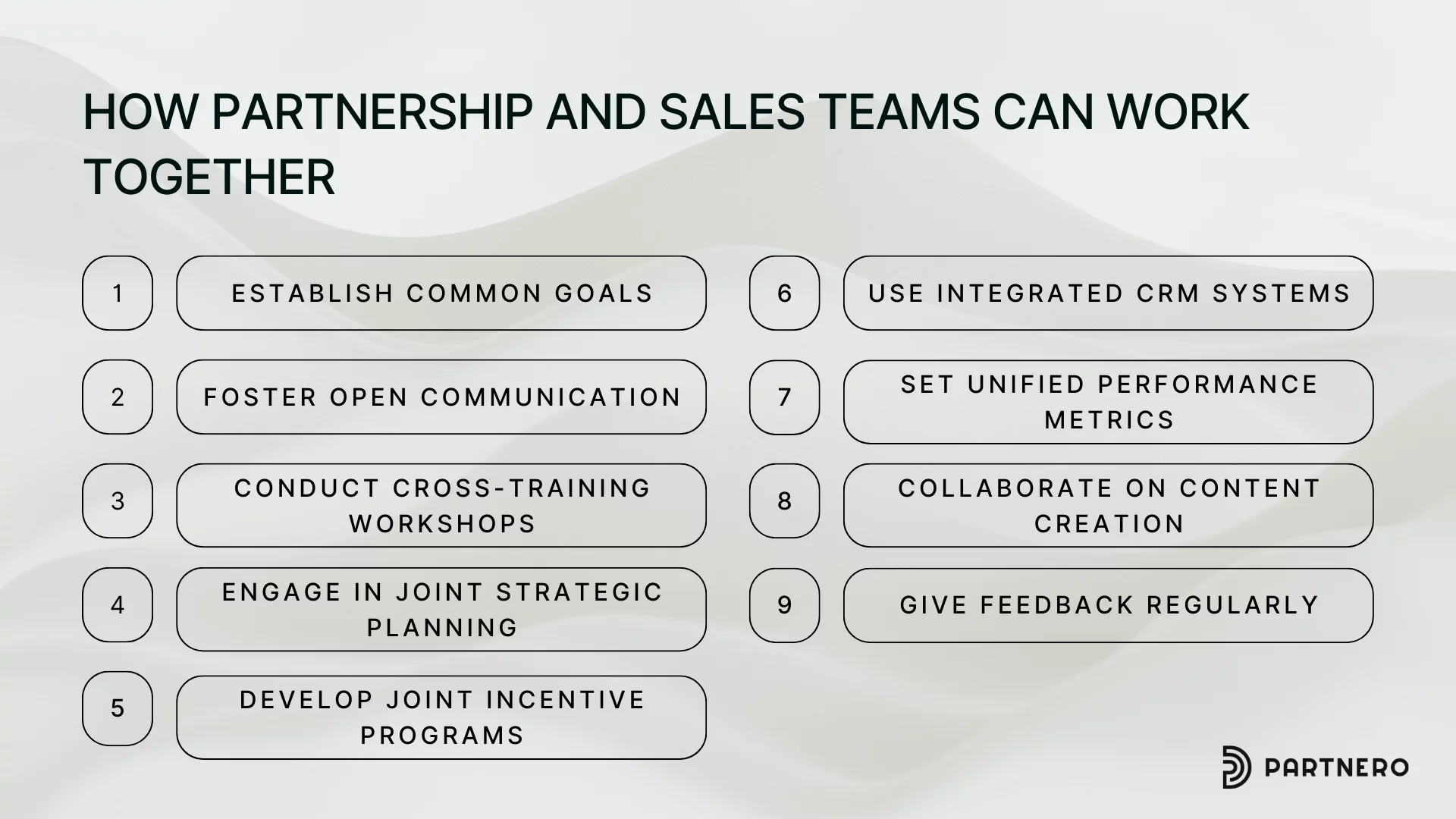
9 strategies for partnership and sales team collaboration to drive revenue
There are so many playbooks out there. However, here are our nine effective strategies to ensure that partnership and sales teams collaborate successfully:
1. Establish common goals
Aligning both teams and workflows around shared objectives is crucial. This alignment guarantees that everyone is aiming for the same targets. This helps to meet business needs a whole lot quicker.
For example, increasing sales, expanding market presence, or enhancing product lines. Unified goals encourage a strategic approach from both teams, and a more cohesive approach, too.
2. Foster open communication
Regular and open communication is essential to collaboration between partnership and sales teams. Scheduling frequent meetings and using daily communication tools like Slack or Microsoft Teams can help maintain clarity, share important updates, and facilitate problem-solving discussions.
You can dedicate a channel solely to #partnershipsandsales to share their #wins. You can also see how both tech stacks could communicate with one another through integrations, so there’s a single view of overall sales. More below!
3. Conduct cross-training workshops
Cross-training workshops allow team members to understand each other’s roles and stakeholders better. This fosters mutual respect and enables effective collaboration.
These sessions can demystify each team's perspectives, methods, and strategies. This is especially important when you want to add marketing efforts into the mix. This leads to improved cooperation, outcomes, and more.
4. Engage in joint strategic planning
Involving both teams in the strategic planning process can lead to more innovative and effective strategies. This requires unique insights and strengths of each team, resulting in well-coordinated marketing campaigns and sales tactics.
The more involved both teams are, the more likely they are to be motivated and work together, too. We’re all in this together, aren’t we?
5. Develop joint incentive programs
Motivate both teams by creating incentive programs that reward collaborative successes. For example, implement bonuses for partnership leads that successfully convert into sales, or for sales teams that effectively use partnerships to close deals.
This will also make it fair between both teams. In many organizations, many partnership teams don’t have as many incentives as sales.
6. Use integrated CRM systems
When you’re choosing a Customer Relationship Management (CRM) system, choose one that will enhance teamwork by providing access to essential data about leads, partners, and customers. This doesn’t have to be Salesforce.
This shared information helps track progress, evaluate the effectiveness of partnership channels, and refine sales strategies.
7. Set unified performance metrics
It’s important to measure the success of collaborative efforts with shared metrics, such as lead conversion rates, the number of new customers acquired through partnerships, or revenue generated from joint initiatives.
In 2026, top-performing teams track metrics such as partner-sourced revenue percentage, influenced deal velocity, and co-selling win rates. Organizations aligned with these teams report shorter sales cycles (often 48% faster per PartnerStack/Wynter 2026 data) and higher close probabilities through better collaboration.
Regularly review these metrics to collaborate and adjust your strategies. Work together to win together.
8. Collaborate on content creation
Are your marketing efforts a bit out of place? Work together to create content that supports both teams' goals.
For instance, develop case studies that showcase successful partnerships, which the sales team can use as proof points. The right partners are hard to find.
Sales insights can also inform the partnership team in creating targeted content for prospective partners. Both insights can also help in LinkedIn or podcast content creation.
9. Give feedback regularly
Create channels for ongoing feedback. This allows both teams to continually refine their strategies and approaches.
Sales teams can provide insights on customer reactions and the effectiveness of sales strategies, while partnership teams can offer updates on market trends and partner capabilities.
Partnero for partnership and sales teams
As co-selling and partnership-sales collaboration become more important, implementing these strategies, backed by integrated tools and shared data, can deliver sustainable revenue acceleration. The right tech stack, such as CRMs with strong automation capabilities, turns collaboration into measurable results.
By implementing these nine strategies, organizations can ensure that these teams work cohesively towards common business goals. The foundation of successful collaboration lies in mutual understanding, shared goals, continuous communication, and having the right tech stack.
That’s where Partnero can help. Make sure your sales and partnership teams are on the same page by integrating Partnero into your tech stack. Want to see all of this in action? Sign up for a free trial.
Launch your program in minutes or get in touch for advanced setups.